Friday, 19 April 2013

COSTA RICA La Selva Biological Station

This conservation area is one of the two most important tropical research institutions in the world.  We stayed here for 3 nights, went on 3 guided walks and felt privileged to contribute our tourist dollars to the enterprise.  Because it covers such a large area and so many diverse habitats, the species list for everything from birds to bats to fish is extensive.
Collared peccaries were often seen
Agouti below our balcony
Male howler monkeys have very loud voices.

3-toed sloth waking up
Another 3-toed sloth peeing


By chance, we had the same guide for each walk, Geiner.  He was great - enthusiastic and happy to search for all creatures.

Two ocelots were seen from this bridge while we stayed here.
Everyone crossing the bridge into the jungle had to wear boots because of venomous snakes.  They gave me rubber boots since my boots had been stolen in Quito.


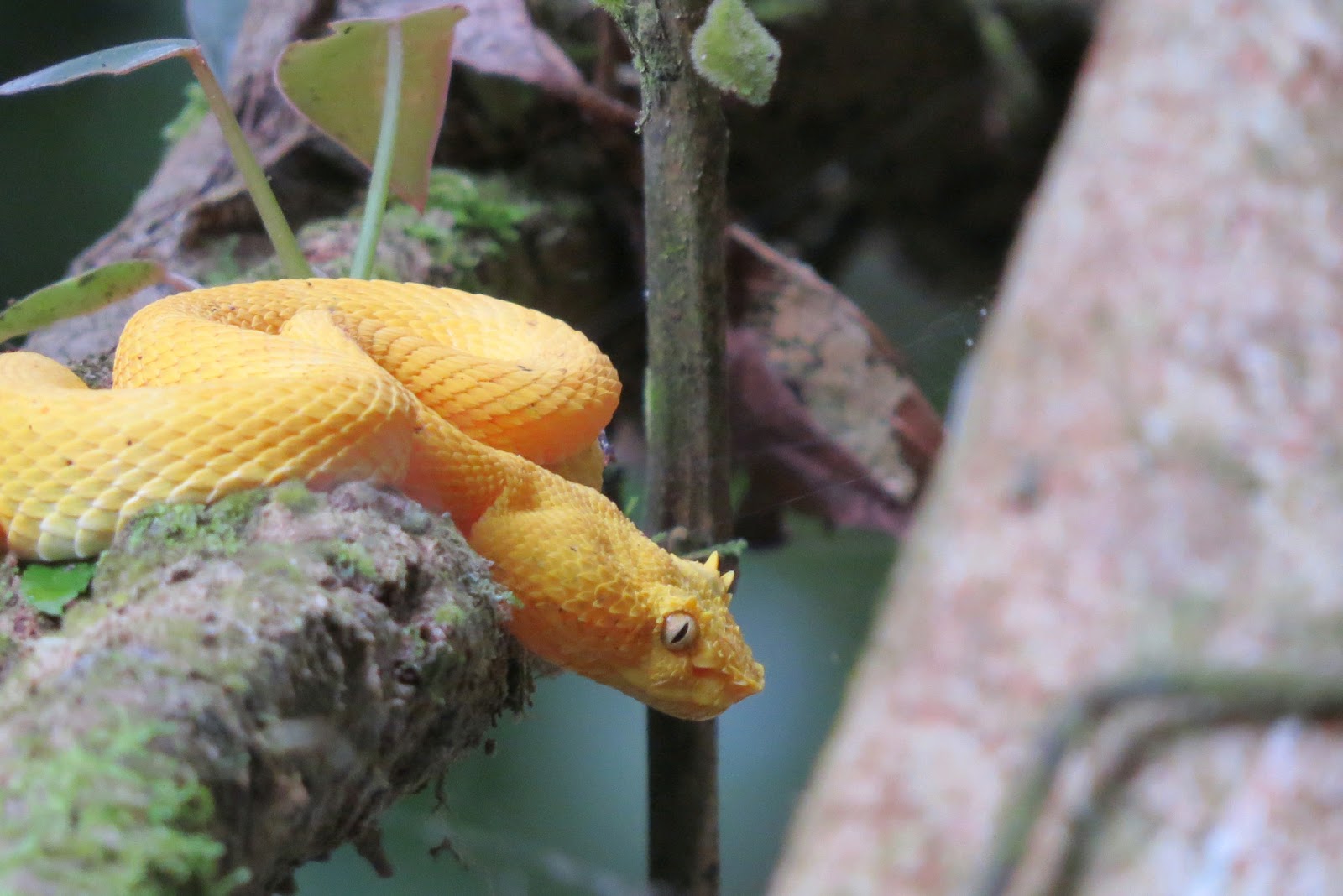
We saw 2 snakes, each less than 1 m and so deadly that the guide used my camera for the first one.

Hog-nosed viper

Eyelash viper
Other reptiles seen were iguanas, turtles, skinks and anoles.
Green Iguanas sat on top of trees near the river.

Rarely seen Helmeted Iguana

Brown wood turtle
Of course, there were many other animals.
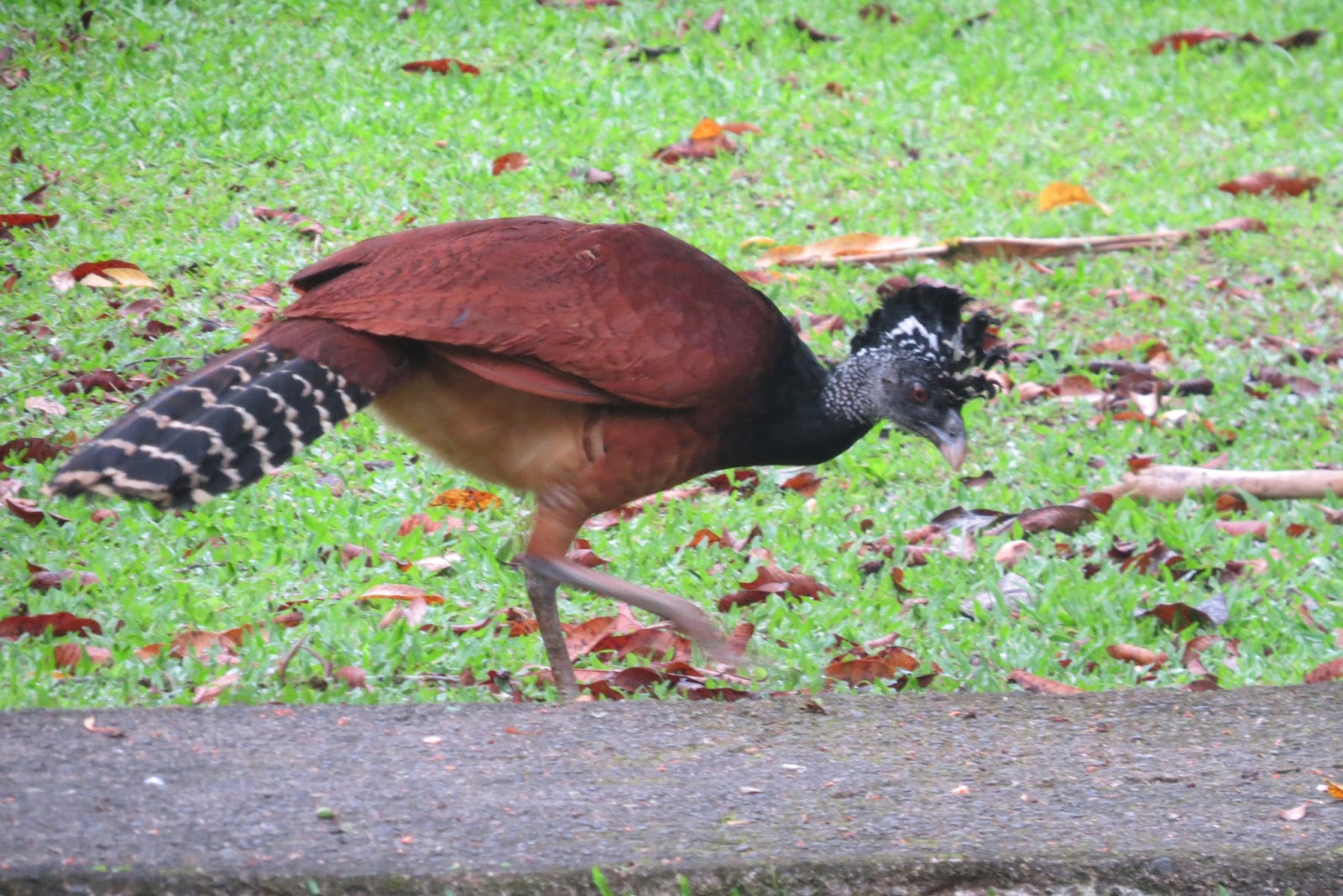
Crested guan
Blue-gray tanager
Passerini`s tanager

Female curassow

Bullfrog

Bullant, feared by all

Poison dart frog aka Blue Jeans, seen everywhere

Mating millipedes


wasps

Golden orb weaver


Invading ants drove these bats out of a post.

White tent-making bats under their leaf shelter

Tuesday, 16 April 2013

COSTA RICA Alajuela

Alajuela is a town near the airport for San Jose.
We stayed there for 2 nights at Hotel Pura Vida which had a lovely garden.  After  getting colones (money) and a SIM we took a cab to Grecia, a supposedly attractive town. We didn't realise it was so far away, $32 fare.  The town had nothing to offer but ordinary shops.  I asked 5 people as we wandered about a bus to Sarchi, another tourist destination nearby.  The bus cost $2.  A policeman told us where to find the House of the Painted Ox Cart.  Here David was happy, as he wandered through this old carpentry shop driven by a water wheel.  I liked the end product and the good souvenir shop.
We got a bus back to Alajuela and alighted into heavy rain.  Taxis were full so we took shelter in a cake shop serving coffee.  The girls there were very nice and directed David to the nearest grog shop for a bottle of Chilean red, $9.  Aussie wines sell for around $18.

At breakfast next morning our Toyota (Daihatsu) Bego was delivered.  Cost is $1230 for 2 weeks, including $350 for total insurance.  It`s a very neat 4WD.  Then we set forth on the 4 hour (we got lost) drive to La Selva Biological Station.  Hmmmm....  We had to negotiate the busy often one-way streets out of Alajuela with me using the GPS (note: NOT a vocal navigator).  My problem was sheer terror - driving on the wrong side of the road.  I really felt that we were always about to plough into parked cars or rip through pedestrians!  David`s main problem was me crying and screaming.  I couldn't shut my eyes because I was navigating.  For most of the drive I looked left.

Friday, 12 April 2013

ECUADOR Mindo, western Andes cloud forest

Various web comments made us think of paying $120 for a return taxi ride to Mindo.  Instead we got the bus for $2.50 each one way - a comfortable fear-free ride.  A $3 taxi brought us to our unique accommodation at La Roulette, with its Swiss atmosphere.  www.roulotte.ec


 The highways in Ecuador are very good but roads around Mindo are rough.   The town has made a commitment to eco & adventure tourism, so slow driving balances zip lining and tubing down rapids.  There were many backpackers and some hippies.
We booked 3 days in Mindo and hired Julia Patino, a very good bird guide, for 2 mornings. A Bavarian couple staying at La Roulotte was excellent company in the dining room and on the first walk.

Lebardo looked after us very well and encouraged me to use Spanish.  The owner is a Swiss chef but I think others cooked when we were there.
Tilapia with coriander, almonds, lime


Lebardo flaming chocolate mousse

Julia showed us many special birds, 56 species in 2 mornings.
Bran-coloured Flycatcher
Lemon-rumped Tanager
Masked trogon
Choco Toucans
Pale-mandibled Aracari, taken through scope with my phone
                           Ornate Flycatcher

Big spider
 On the second day Julia picked us up at 5am and it was still dark 40 minutes later when she led us down a steep hill on the property of Angel Paz.  Surrounded by wet forest, I was glad to grab occasional cables to guide me away from ravines.  We had to get to a certain place by 6am to see the Andean cock of the rock perform.  His `dance` was quickly over, no time for us to get a photo.
However, banana feasts were available for many other birds.
Emerald Toucanet
Toucan Barbet
Blue-winged Mountain-Tanager
Sickle-winged Guan
Dark-backed Wood-Quail
A guide from Angel Paz led us up the track, making strange calls and carrying a small container of live worms.  He first attracted a dear little bird, the Ochre-breasted Antpitta, which is known as Shakira because it shakes its body from side to side.

More worms and different calls enticed the Moustached Antpitta.  We also saw an Ocellated Tapaculo.
After a late and very good breakfast at the Paz property, we returned to watch hummingbirds at La Roulotte.

 On our last day we walked to a nearby butterfly farm which was very interesting and beautiful.


One Owl butterfly decided to investigate my nose.

Wednesday, 10 April 2013

ECUADOR Quito

Our Napo adventure ended with canoe trips and a plane from Coca to Quito.  David was away a long time, looking for an ATM while I waited next to the information desk at the brand new Quito airport.  I turned my head to look for a seat and our cabin bag was stolen, containing our computer, my boots, 2 jackets and $300 in a money belt.
 So our Quito experience centred on talking to police and replacing lost items.  No-one spoke English at the tourist police station, but they had an interesting way of dealing with us. A nice young woman brought up the appropriate form on computer, I typed a statement, he got the computer to translate, then painstakingly fixed the Spanish version, while I looked over her shoulder.  We got a copy for our insurance claim.
We had booked accommodation for 2 nights at Hostel LA Rabida, where a very pleasant and efficient lady, Gloria, helped us with directions and tourist info.  Buying a new computer involved several cheap ($2 or $3) taxi rides.  So now we have an Android tablet, which led to a lot of homework finding software and getting used to having no control A, X, C or V keys.
As for Quito itself ... it has 4 million people, huge ravines with flat tops, the highest altitude of any capital city at 2800m, footpaths in poor repair, lots of construction, few trees.
 We went up the Teleforico for good views.


The Casa del Alabardo has a fascinating collection of pre-Columbian items.


The historic Old Town was boring.  Churches covered inside with gold (no photos) allowed, colonial civic buildings, etc.  One pedestrian street as pictured below.

There was some tourist nightlife up Reine Victoria near our hostal.

The beer is good!


Monday, 8 April 2013

ECUADOR. Napo Wildlife Centre

Mauricio drove us from San Isidro down to Coca on the Napo River.  The trip took 2 hours  on a good winding road.  There Andres showed us 6 different swallows and martins. A fast motorized canoe with roof was packed with luggage and 16 tourists for a 2 hour ride to a creek.  There we transferred to 4 canoes, each with a  naturalist guide speaking English, a native guide and a paddler.  We were split up by nationality (and perhaps age) for the next 3 days, 4 Aussies, 6 Brits, 4 Yanks plus 2 Germans.  The 2 hour paddle up the narrow creek was the start of our adventures.
 We could have touched the anaconda lying half out of the water with the agouti-shaped bulge in its body.  Five species of monkey were seen - squirrel, howler, saki, woolly and capuchin.  We saw  2 two-toed and 2 three-toed sloths, several caiman and the family of 7 giant otters on 2 days. My bird list was 73 species in 3 days, including herons, toucans, parrots (but no macaws), many kites, tanagers ... I weep for the photos we don't have.
Our small group had the best naturalist guide, Delfin.  He is from the Kichwa tribe, which runs the enterprise and he found so many animals for us.  He even used our camera to get  better photos.  The most exciting sighting for him was a Harpy eagle atop a bare branch some 500m away.  We had climbed  the 200 (?)  steps up the Observation Tower and this was only his third sight of this magnificent bird.
 Near a clay lick we visited a Kichwa village where the women sang, danced and showed cultural items.  Their men run the resort and the women decided on their own contribution.  It was very interesting. The resort was luxurious and we felt the cost of $890 each was not too high for 3 days in the Amazon basin.

Squirrel monkey
David had a movie of 7 giant otters swimming close to us.

Harpy eagle

Add caption